
The universal language of seafood luxury × Japanese-style live crab. The 'premium crab' category, still unclaimed, defined first from Tokyo.
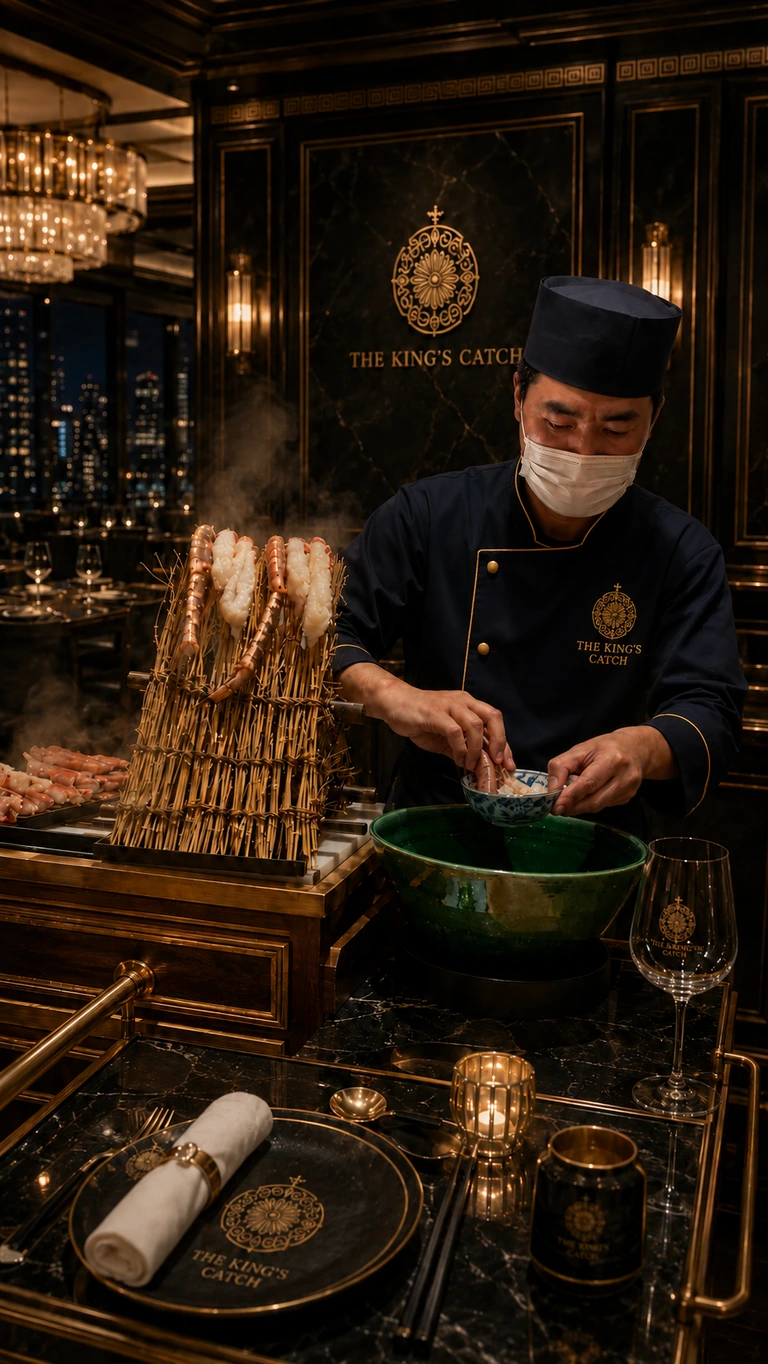
Product DNA — why now, and the gap in the world
The whitespace of live crab × global luxury.
Everyone in the world knows crab. But 'this' — no one has yet experienced it.
Know live crab — but never as world-class luxury.
Know sushi, teppanyaki — but not live crab, Japanese-style, tableside.
Live crab × Japanese cuisine × world-class design — bundled here for the first time.
The Moat — why Tokyo can be taken first
A moat latecomers cannot break — 4 conditions converge.
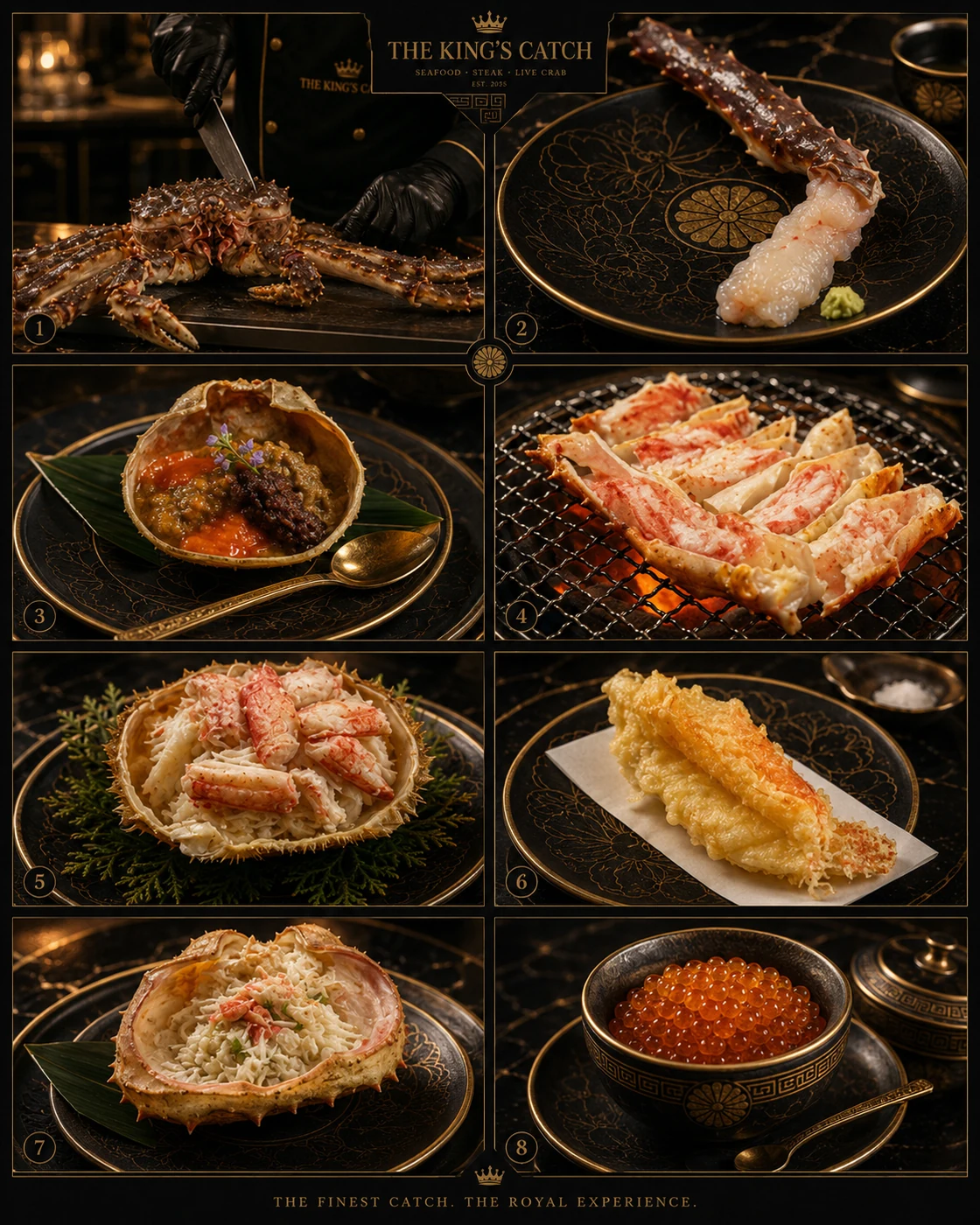
Preparation diversity turns 1 crab into 8 dishes.
Finest Russian king crab, legally imported — lowest cost among surveyed markets (see city comparison).
Stage, capital, reach — build the format, take it worldwide.
Inbound affluent come to you.
The convergence = a moat latecomers cannot break.
Cost to recreate this in 7 cities — launch cost and live supply+−
Tokyo ¥48,000 ≈ $300/guest baseline for same quality and margin (food, rent, fit-out, labor). Per-city context in the appendix.
Other cities stop at 'tank → kitchen.' Finished at every seat; live butchery in VIP.
Proprietary asset latecomers can't buy (figures in 'Launchpad').
Live crab × Japanese cuisine × global luxury — first mover (see 'Product').
One byword per category — pre-empt it (the Nobu benchmark lives in 'Scale').
Asymmetric payoff — limited downside · open-ended upside+−
Base-case operating profit = the floor
Category definition → JV → stake sale.
Market & Position — real demand and the sweet whitespace
A moat matters when there's demand to catch.
Only possible in Japan × not too Japanese
Two proofs — Kitafuku's overflowing demand and COTE's global record+−
16 seats · 3-4 parties/day · ¥43-58K/guest. Demand clearly overflows.
Tableside grill ritual × wine bar; multi-location ($150-160). Theater × hybrid = format to inherit.
The Product — the theater of live king crab
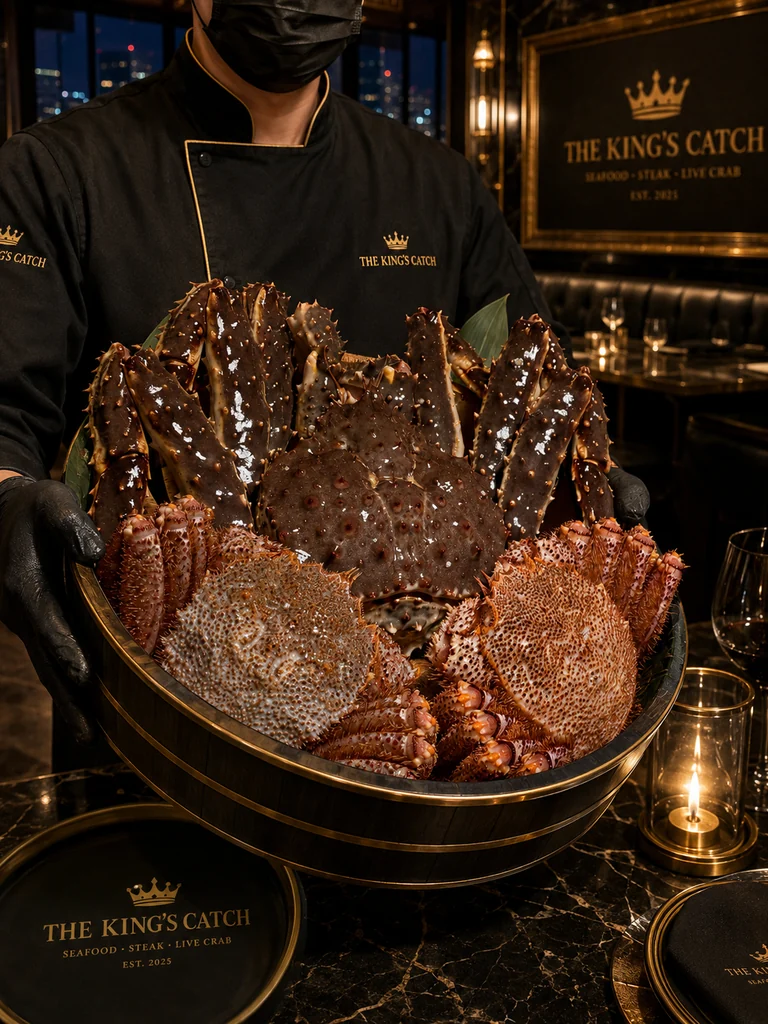
Live king crab chosen by weight — three pillars, eight preparations.
The Theater of Crab — 3 Pillars
One live king crab transforms 8 ways+−
Live-crab sweetness and translucence
Swished through hot broth until it blooms
The classic — the umami of the legs
The aroma of charcoal fire
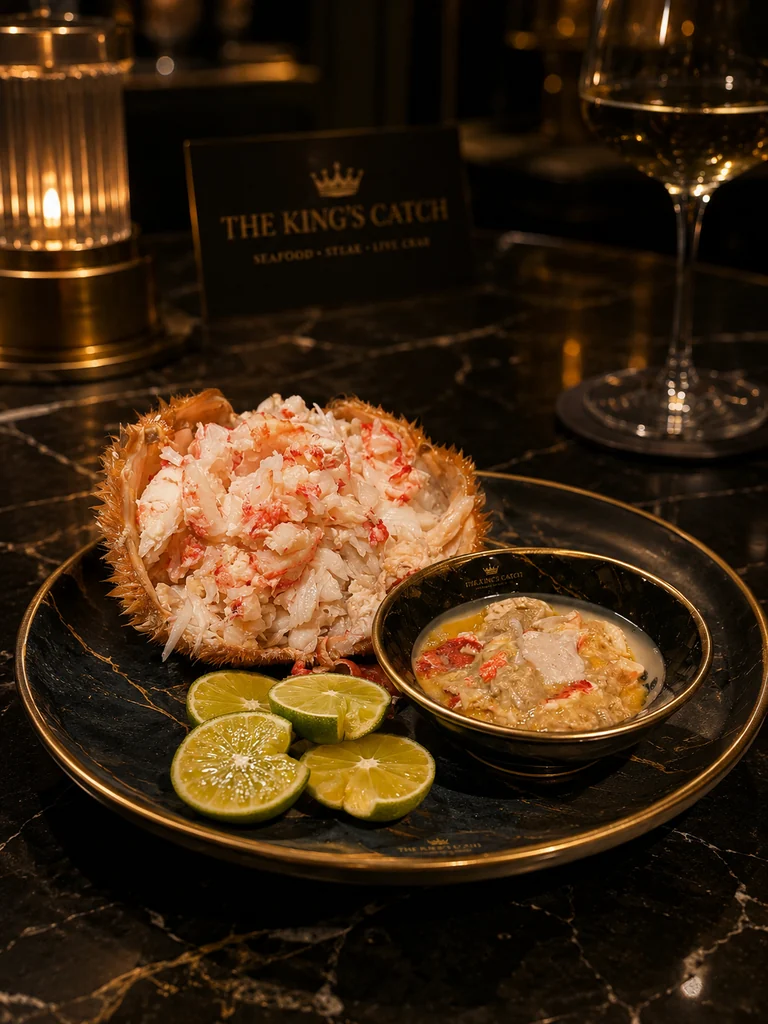
Crab miso bubbling in the shell
Crisp batter, fluffy meat
Dashi into the rice
Sashimi × salt and caviar
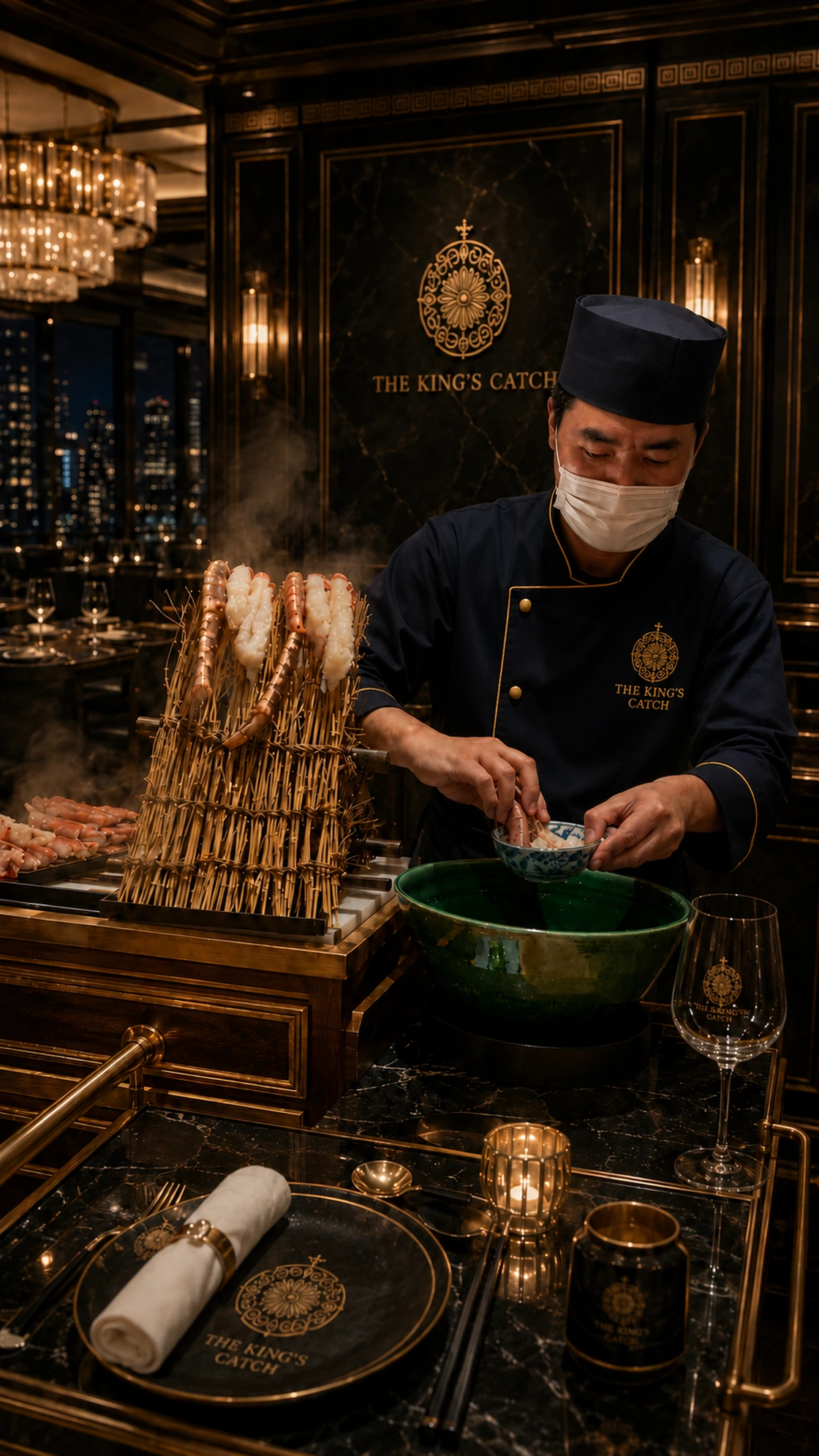
Choose by Weight: the Giant Live King Crab
Guests pick, the weight is called out at the scale, and the crab is finished tableside. 1 crab per table, shared (2-8 guests).
The service flow — how the spectacle unfolds+−
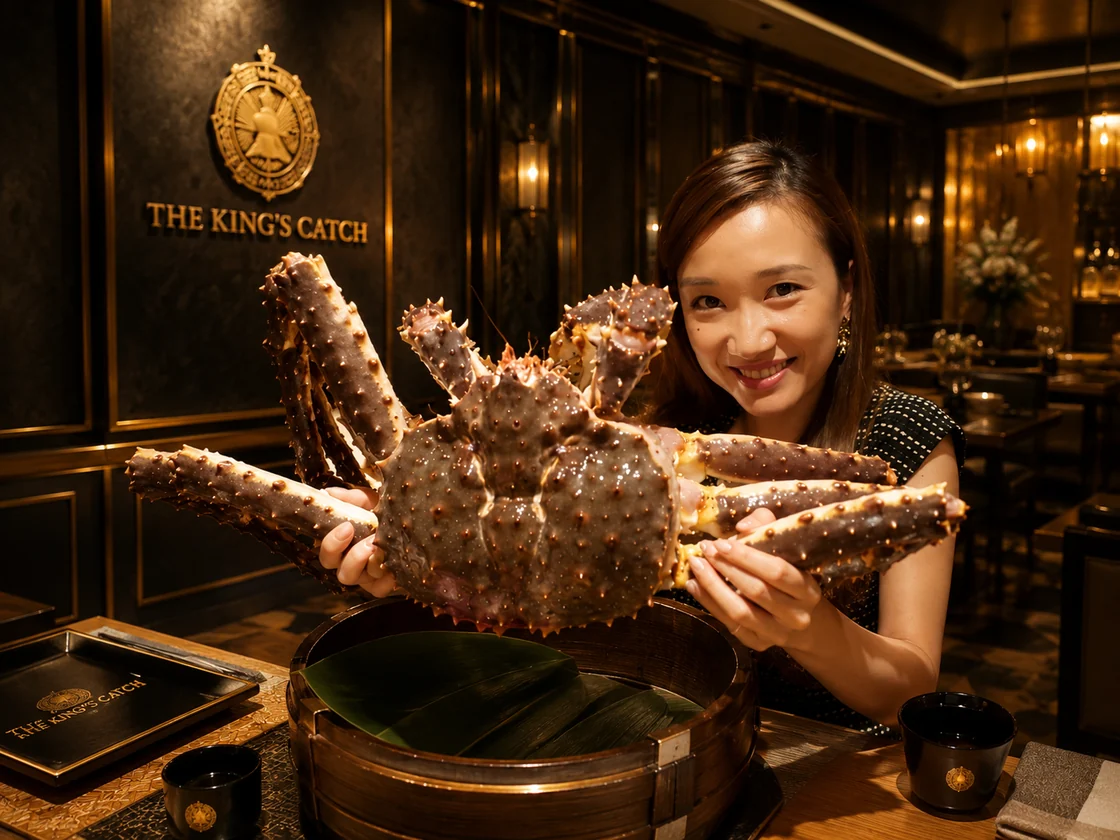
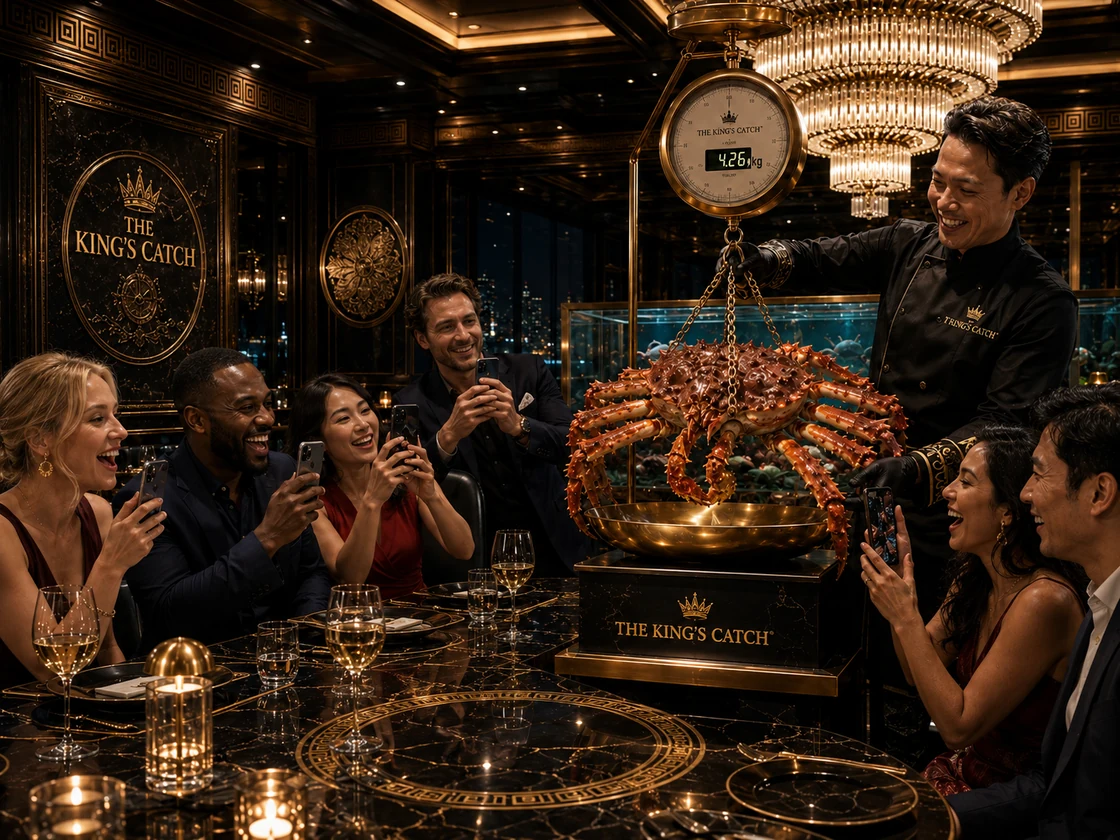
The weight — one number — spreads on its own+−
Raw bar on tiered ice
Bluefin, abalone, scallop, ikura, oyster, uni, caviar — à la carte. High margin, quick, photogenic.
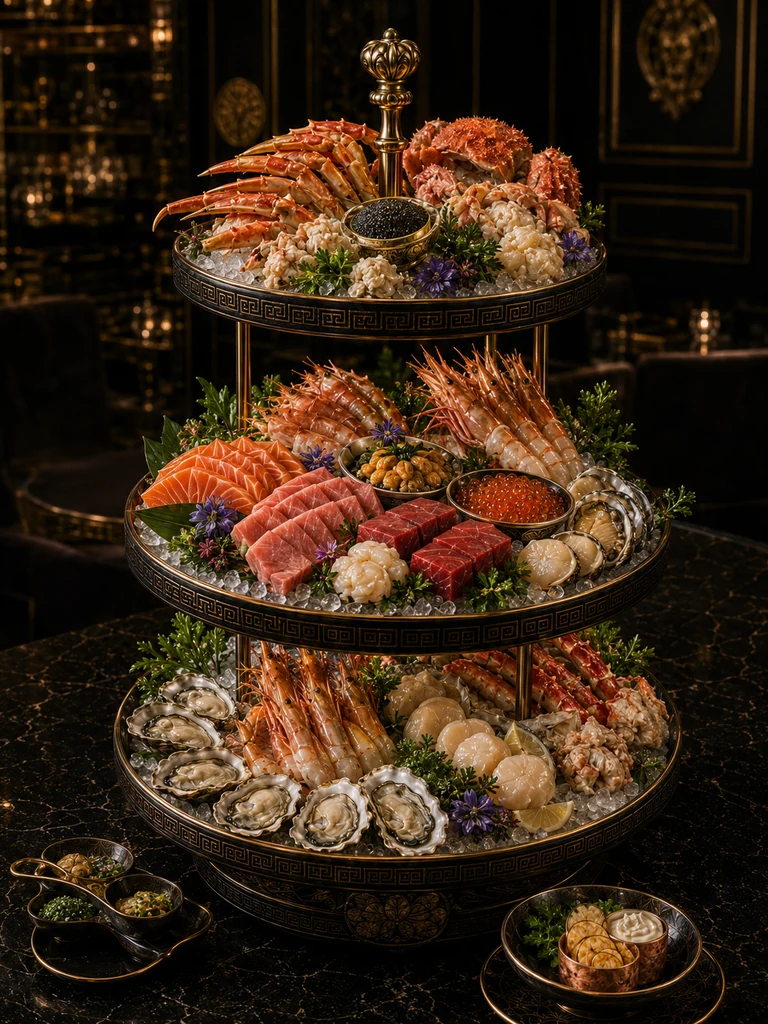
All ten à la carte items on a three-tier ice stand. Maximum table impact.
Uni and crab market price. Full detail in appendix menu.
Smaller tiers — build the platter to size+−
Order upward from one item; the opening photo plate for 2-6 guests.
The Design — Japanese craft in Western ultra-luxury
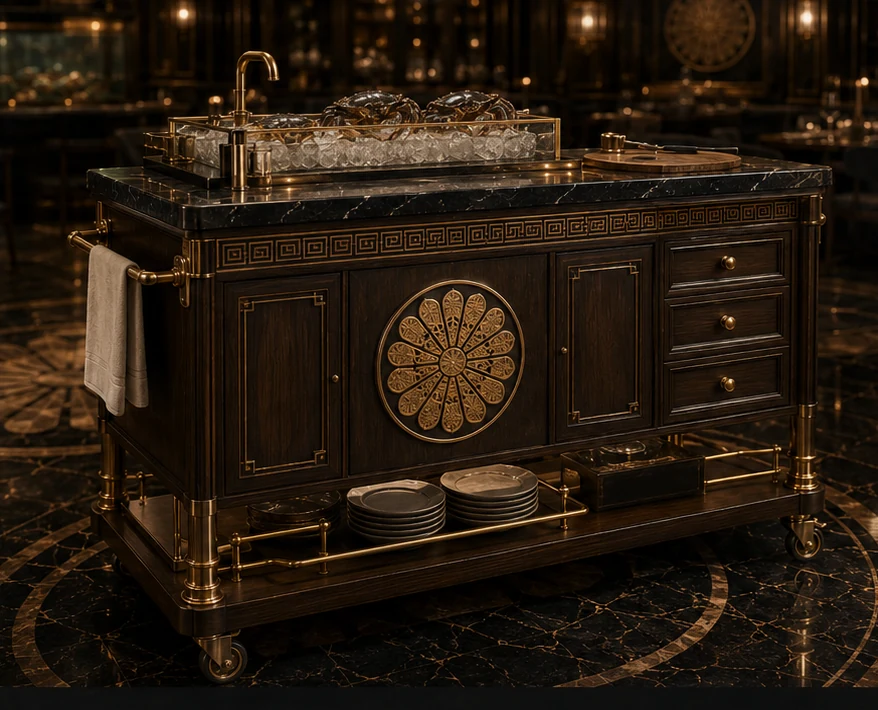
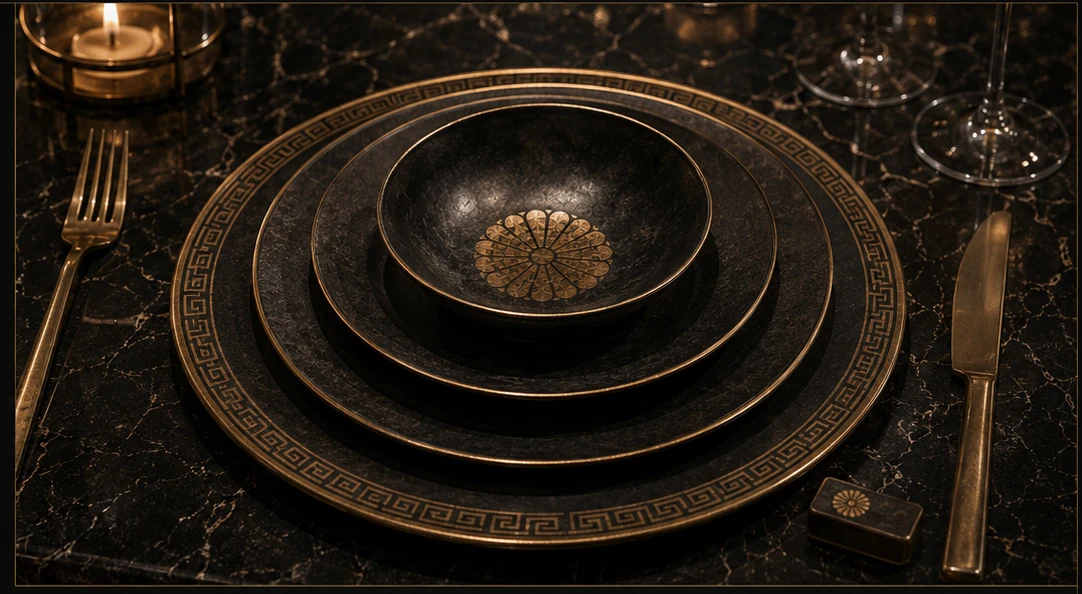
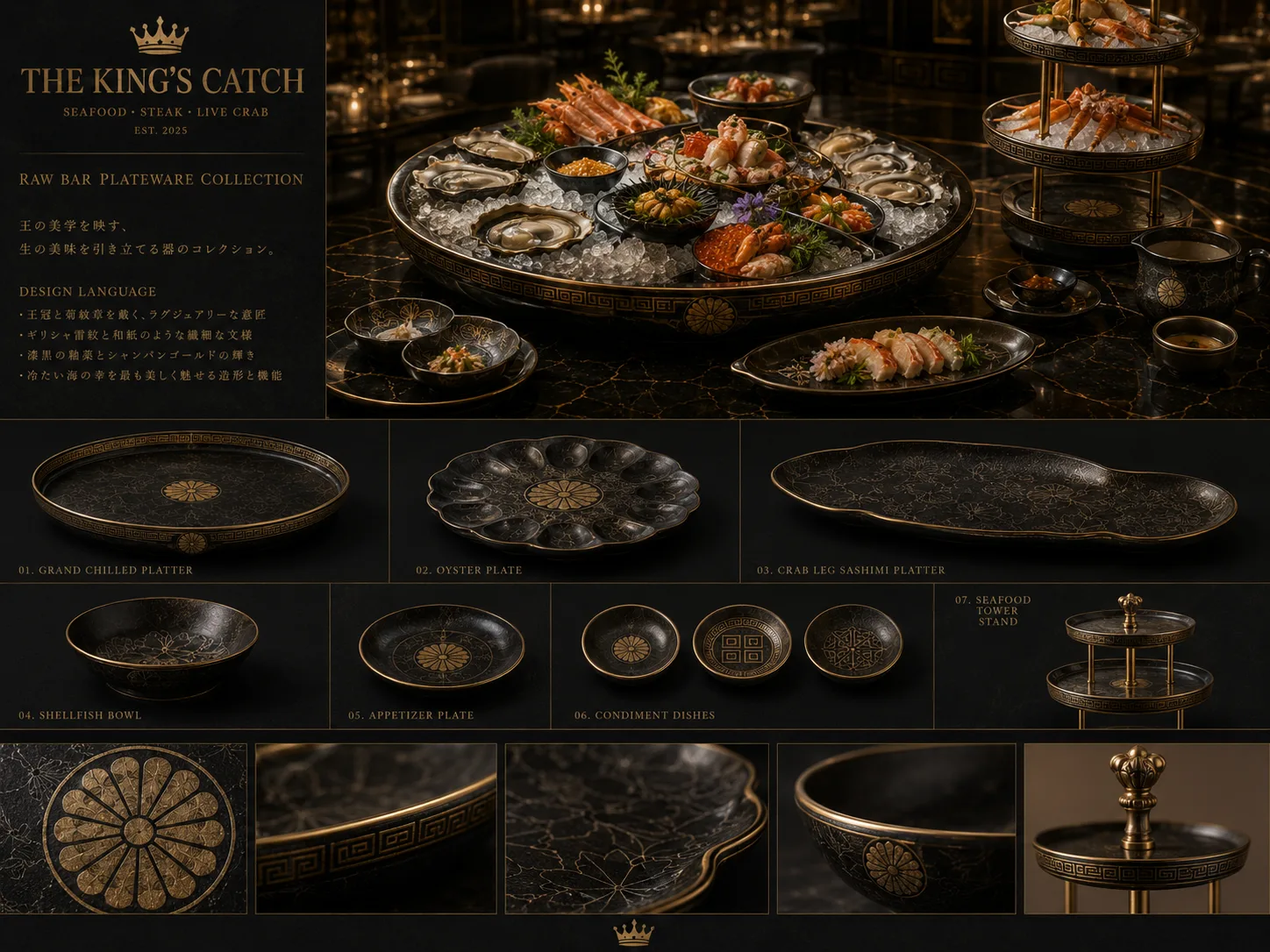
The design speaks visually — one language from logo to plateware.
Japanese craft, framed in Western ultra-luxury
The design language — three logo variants, the fusion thesis, the consistency matrix+−
LOGO — three variants (the marks shown in the header)+−
Crown, chrysanthemum, Greek key and shield: one vocabulary, three marks.

From logo to plateware, one language
Gold = the vocabulary appears at that touchpoint. Chrysanthemum, Greek key and navy × gold are the shared core across all touchpoints; champagne gold, brass and marble are applied per element.
THE KING'S CATCH — Bespoke Spatial Concept


Design detail — motif system, design boards, materials & cost per tsubo, the ambiance effect+−
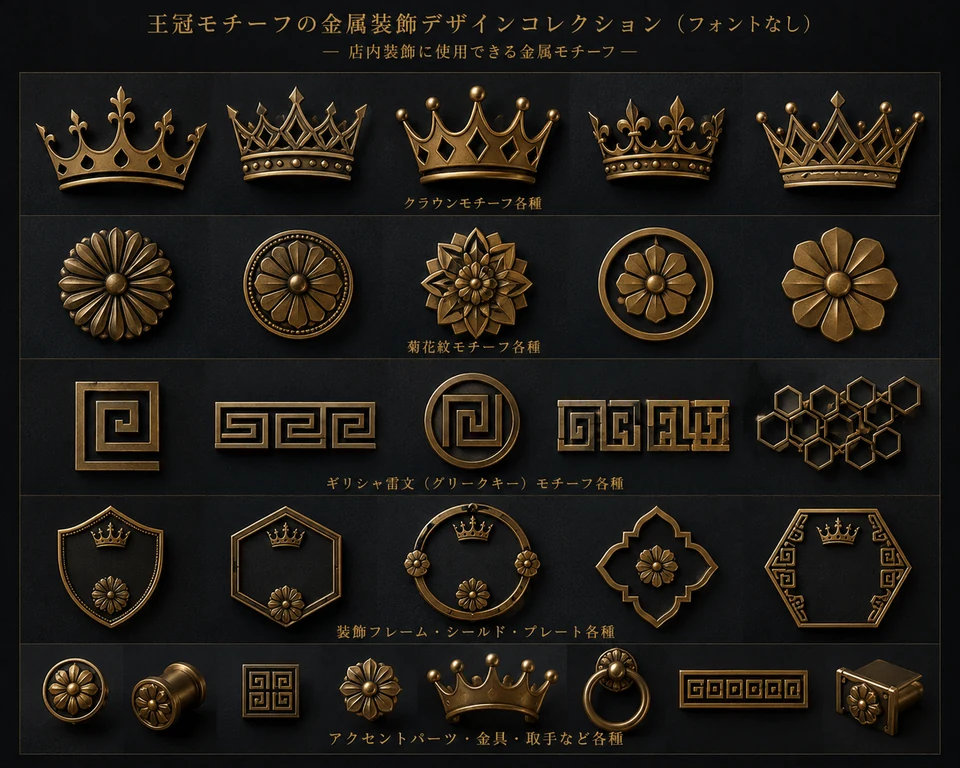
12 decorative frames & emblems — the applied catalog+−

Detailed design boards — entrance · restroom · uniform · chandelier (4 boards)+−
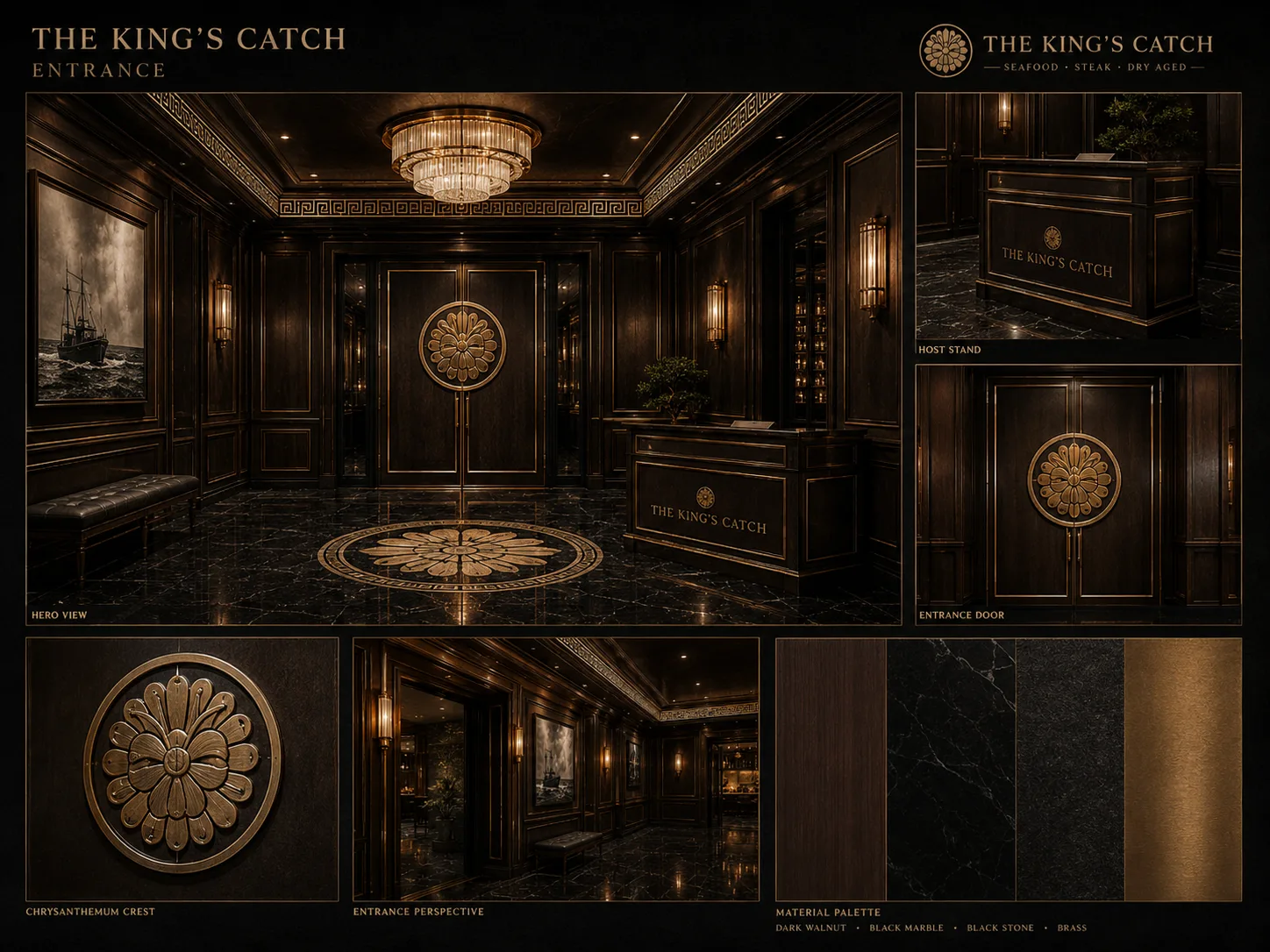
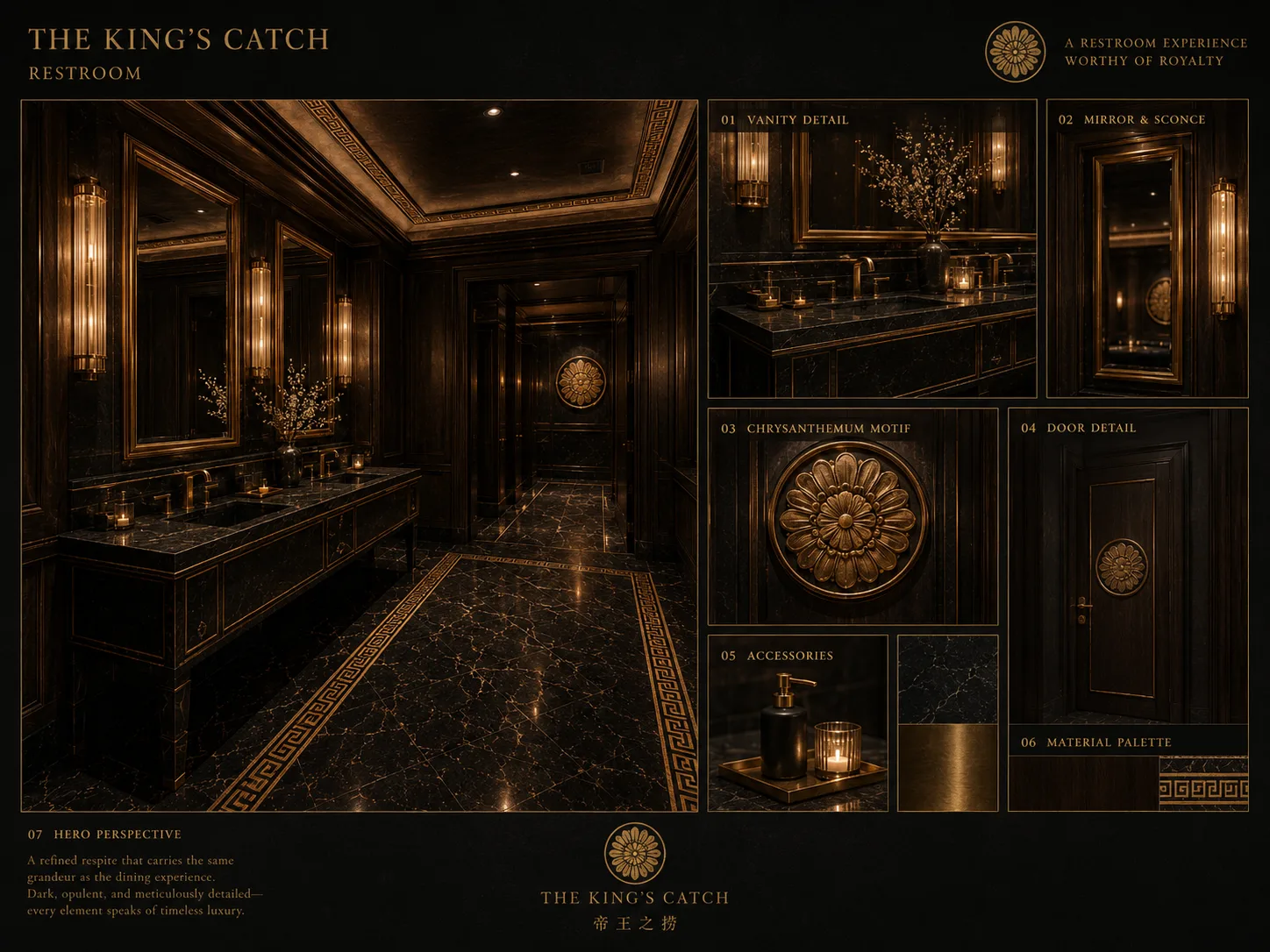

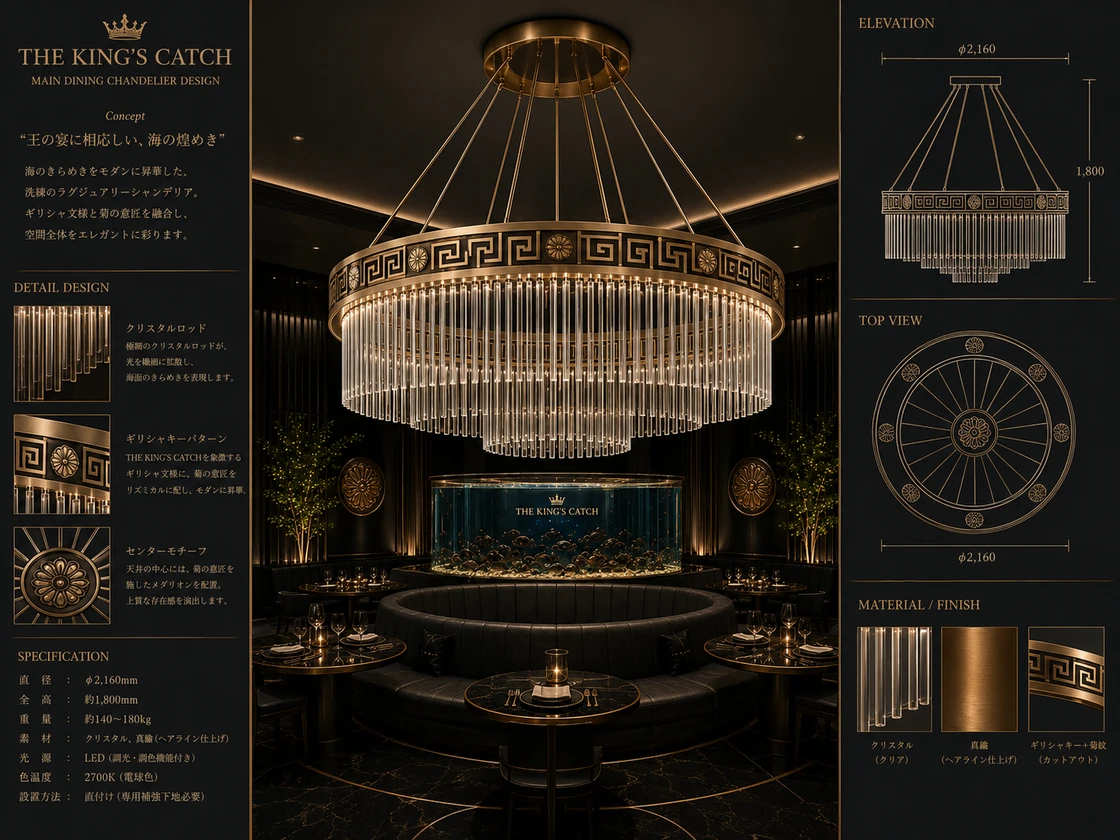
Concept visuals. Dimensions, egress, tank load, kitchen, exhaust and maintenance are fixed in detailed design.
Why the Space Raises What Guests Pay — The Evidence — research evidence (5 findings)+−
At higher tiers, interior quality and spatial drama lift experience value and willingness to pay. THE KING'S CATCH uses that logic: a 54-seat theater, all-seat tableside finishing and service, and genuine materials.
Food leads; service and space lift it. The room is a device that makes the crab look better, with height, staging and acoustic absorption built into design.
Up to 54 seats: dining ~48 + show bar 6. Every seat sees the live crab tank (details in appendix).
![THE KING'S CATCH full floor layout & seat plan [final] — max 54 seats + 6 show-bar + 2 VIP rooms (4 + 10) = 54 total. SHOW BAR / KITCHEN / SERVICE / STAIR / 3 central shared zones / 8-seat wall banquettes on each side / LIVE TANK / ENTRANCE / VIP rooms I & II, chrysanthemum-medallion floor + Greek-key border, material & pattern legend (black marble / beige marble / Greek medallion / black-leather sofa / gold + brass)](/images/interior/tkc-floor-plan-final-1672.webp)
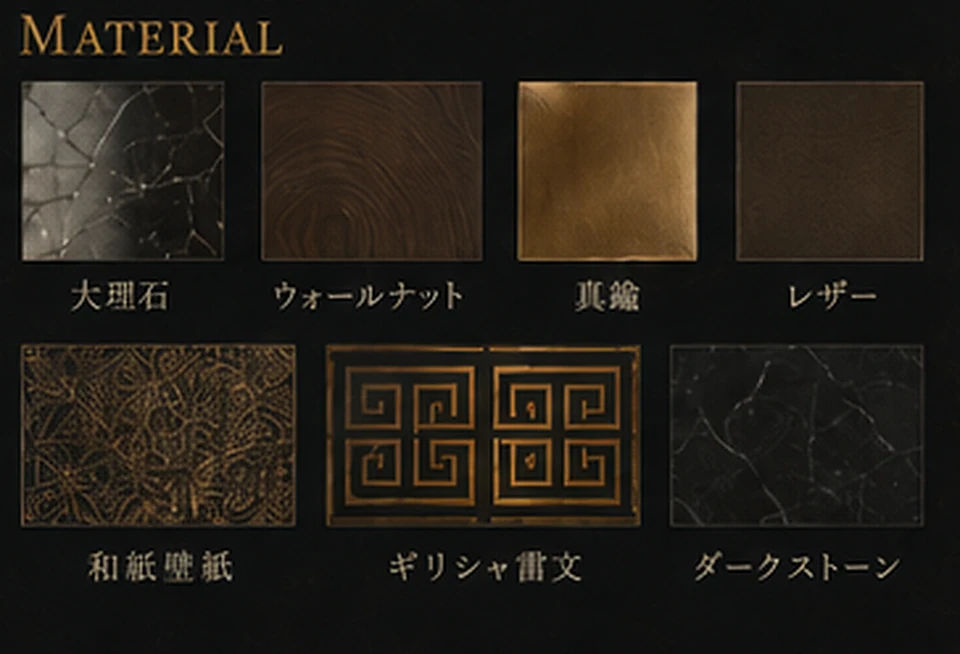
MATERIAL & MOTIF — the material palette+−
The Numbers — so, is it profitable?
Does it make money? Broken down in three layers.
Business specs and financial outlook
Location Prime Tokyo: Ginza · Akasaka · Roppongi · Azabu · Toranomon · Hiroo · Omotesando · Jingu · Up to 54 seats (dining ~48 + bar 6) / approx. 80-84 tsubo
Total Funding Plan — OpCo BS ¥320M + Off-BS ¥25M = Partner Funding Principal ¥345M
The headline total cash need of ¥380-420M is broader than Partner funding principal of ¥345M. The OpCo balance sheet carries ¥320M (build-out, deposit, working capital), with ¥25M of BookYou-side pre-opening expenses off-BS. Supervision and contingency reserves bring required cash to ¥380-420M.
The four layers — build-out ① through pre-paid expenses ④+−
Interior / kitchen / live tanks / fixtures (breakdown below)
≈10-12 months' rent deposit for a prime building of 80+ tsubo (total acquisition with key money / brokerage / advance rent ≈ 13-16 months' worth)
Fixed-cost buffer for the first 6 months after opening
Property acquisition fees (key money / brokerage / stamp / registration) · recruiting agency retainers · pre-opening marketing initial (paid by BookYou, delivered to OpCo as services)
OpCo BS ¥320M + Off-BS ¥25M. Partner → BookYou ¥280M (matches NOL) + Partner → OpCo ¥65M
Broader required-cash range after supervision, contingency and safety margin; not the same as loan principal.
Economics (¥250M · max 54 seats)
This flagship's profit is the self-funding foundation for building a world-class brand — the reason we can bet on the upside while we defend the downside. Profit has a three-layer structure. Customer prices are tax-inclusive; exemption/taxable status is determined per period.
Blended all-seat occupancy of 66% sits inside the healthy restaurant band (65-70%) — the numbers live in the band and tiles below.
Reservation defense+−
Every reservation has a card guarantee plus late-cancellation fees, and top tiers are prepaid (Tock-style). This suppresses no-shows (a ¥200B/year issue in Japan) and inbound cancellation rates of 25-30% (TableCheck). The first-year floor is designed to be filled by the launchpad: roughly 100 regulars at the ¥300K tier plus referrals.
Sources of profit — revenue composition, gross-margin contribution, the order basket+−
Food (live crab) is the largest gross-profit base — direct vessel delivery (¥12,000/kg = Toyosu live × 0.8) beats market prices and yields a ~63% gross margin. On top of it, 73% drink gross margin + VIP room fees lift the overall margin = a design tilted toward drinks at every table is quantitatively correct.
The ¥48,000 check isn't a vibe — it's the weighted average of the order mix: course + drinks + weight-priced taraba + raw bar + room fee. Below is what one cover actually orders (mix derived from the revenue-build floorSplit).
Figures are pre-tax menu spend. The 10% service charge (+¥5,168/cover) is booked as revenue and funds the 24-person tableside-service roster.
Bottom-up weighted check = ¥51,680/cover; the ¥48,000 headline rounds down by 7.1%. Main sensitivity = drink attach rate, tested in the bear case.
How the P&L is built — waterfall, the profitability gate, sensitivity+−
An All-or-Nothing structure that is profitable only if 'all' five conditions below align. The ways it can break are noted alongside.
Each cell is dining-only operating profit (before bar, late-lounge and room-charge uplift). The full-company base case adds ~¥25M = ¥199M.
Statement of Operations (5 years × 53 lines)
Open the full statement — 5 years × 53 line items+−
| Item | Y1 | Y2 | Y3 | Y4 | Y5 | CAGR | Note |
|---|---|---|---|---|---|---|---|
| ▶1. Total revenue | ¥615M | ¥728M | ¥799M | ¥827M | ¥847M | 8.4% | Note 1 |
| ▶2. Total COGS | (¥181M) | (¥218M) | (¥241M) | (¥250M) | (¥257M) | 9.3% | Note 2 |
| ▶3. Total labor | (¥188M) | (¥198M) | (¥206M) | (¥216M) | (¥225M) | 4.6% | Note 3 |
| ▶4. Total rent | (¥39.0M) | (¥39.0M) | (¥39.0M) | (¥39.0M) | (¥39.0M) | 0.0% | Note 4 |
| ▶5. Total other SG&A | (¥75.3M) | (¥90.7M) | (¥90.0M) | (¥82.0M) | (¥78.0M) | 0.9% | Note 5 |
| ▶6. Total D&A | (¥24.9M) | (¥24.9M) | (¥24.9M) | (¥24.2M) | (¥24.2M) | -0.7% | Note 6 |
| = Gross profit | ¥434M | ¥510M | ¥559M | ¥578M | ¥590M | 8.0% | Note 7 |
| Gross margin | 70.6% | 70.1% | 69.9% | 69.8% | 69.6% | ||
| = EBITDA | ¥132M | ¥183M | ¥224M | ¥241M | ¥248M | 17.1% | Note 8 |
| = Operating profit (EBIT) | ¥107M | ¥158M | ¥199M | ¥217M | ¥224M | 20.2% | Note 9 |
| EBIT margin | 17.4% | 21.6% | 24.9% | 26.2% | 26.4% | ||
Move the levers, watch how the profit forms
Four levers — occupancy, check, food cost and drink share — plus three scenarios (Bear / Base / Upside). Move a slider and operating profit recomputes instantly.
Open the simulator — four levers × three scenarios+−
Founder's Built-In Demand Base (Launchpad) — Opening-Day Momentum
A new restaurant's biggest weakness is the first six months, when nobody knows it exists. Around 100 regulars at the ¥300K-per-visit tier plus a handful of prominent names eliminate empty-seat risk and light the buzz — opening momentum money can't buy for a latecomer.
Inside the launchpad — three effects+−
About 3 visits a year yields ~¥90M of baseline demand plus accompanying guests. This tier averages 8-16x the top 3-4% of the market.
Generate UGC starting from high-influence guests, creating opening momentum in-house.
Y1 is normally a loss-making awareness-building period. The launchpad's momentum makes it profitable from year one. Margin is compressed below the steady state by opening costs.
Scale & Investors
The real upside — and the investor one-pager.
Not the Number of Locations — A Path to Define the 'Premium Crab' Category and Build a World-Class Brand
The four stages — flagship → domestic → Asia JV → global #1+−
Benchmark — the multi-location scale of premium steak+−
We aim, in the untapped category of 'crab,' to replicate Nobu's trajectory of turning 'Japanese fine dining' into a global category and reaching a ~$1.3B scale — with no incumbent, the ceiling is even higher. The $1.3B is a valuation of the brand, not restaurant EBITDA = the real exit prize is selling the category brand IP (buyer = the wholesaler-investor or a luxury conglomerate).
Raw bar × the breadth of seafood — hedging single-crab risk + lifting the check
Crab is the lead, but the plate is not crab alone. Iced tiered platters (abalone/uni/caviar/oyster) and the breadth of Japanese technique thin the single-supply risk of live crab at the plate level while lifting the average check.
Three ways breadth thins the risk+−
Sharp on crab, defended by the breadth of seafood — structurally erasing single-item fragility.
Partner — From Funding Principal to Full Recovery
Partner (lender + 50% shareholder) provides ¥345M as interest-bearing funding principal, then under the plan recovers ¥454.3M in cash within 36 months of opening. Total cash need is ¥380-420M once supervision and contingency reserves are included. Recovery is performance-linked and not guaranteed; the 50% equity at exit is separate upside.
The five steps and the year-by-year cash flow — funding ① through exit ⑤+−
Annual Partner cash flow — planned ¥454.3M planned cash recovered in 36 months+−
| Year | Principal | Interest | Food GP | Annual total | Note |
|---|---|---|---|---|---|
| Y1 | ¥123.9M | ¥5.5M | ¥33.0M | ¥162.4M | Fee + food trading start |
| Y2 | ¥145.0M | ¥3.5M | ¥33.0M | ¥181.5M | Revenue ramp |
| Y3 | ¥76.2M | ¥1.3M | ¥33.0M | ¥110.5M | Full repayment + NOL used up at M36 |
| Total | ¥345M | ¥10.3M | ¥99.0M | ¥454.3M | Planned cash recovery |
BookYou-First Recovery · 36-Month Capital Structure
BookYou Initial Recovery Master Operator Structure — the capital design that fully recoups in 36 months, on one page. BookYou utilizes its existing tax-loss carryforward while the two loans are repaid from the restaurant's Initial Master Operator Fee and its cumulative operating cash flow (see the Partner Roadmap above for principal breakdown and year-by-year CF).
THE KING'S CATCH is BookYou 50% / Partner 50% from inception (unchanged in all periods).
Joint economic value, the tax mechanism and the official sources (NTA)+−
BookYou uses its existing tax-loss carryforward during the 36-month Initial Recovery period while acting as Master Operator. The model compares corporate-tax savings with non-creditable consumption-tax cost and selects the combined after-tax optimum. After recovery, the special fee ends and economics normalize to 50:50. Tax outcomes require professional confirmation before signing.
- https://www.nta.go.jp/taxes/shiraberu/taxanswer/hojin/5762.htm
- https://www.nta.go.jp/taxes/shiraberu/taxanswer/shohi/6153.htm
- https://www.nta.go.jp/taxes/shiraberu/taxanswer/shohi/6221.htm
- https://www.nta.go.jp/taxes/shiraberu/taxanswer/shohi/6501.htm
Tax outcomes are not guaranteed; confirmation by a tax accountant / lawyer / labor consultant is required before signing.
In closing — the throne of crab no one in the world has yet taken, and its first serving
Bring the Peter Luger / COTE fever for giant meat to the giant live king crab. King crab is literally the king of crab — the name itself becomes the experience. The opposite of Kitafuku (★, 16 seats, hushed tatami): flame, cheers and a guest crowning the king they chose on the scale. The bet is the first serving on the throne of crab no one in the world has yet taken. Nobu turned Japanese cuisine into a global language; the next white space is crab, and its first serving begins in Tokyo.
Partner principal ¥345M (interest-bearing, two-tranche) + BookYou 50% / Partner 50% (unchanged from inception). Recovery path (36-month full repayment) and exit — see the capital structure and roadmap above.
B2C luxury dining = can be complementary to the investor's supply business (confirmed through discussion). Shigeto = brand, experience, restaurant, customer base.
Domestic multi-location + Asia capital-partnership JV → sale of the operating-company stake. The real prize is selling the 'category brand IP' = buyer is the wholesaler-investor itself or a luxury conglomerate (valuation per the exit enterprise value in the capital-structure one-pager — normalized EBITDA × 8x; Nobu ~$1.3B is a brand valuation)
Meeting → property viewing → drafting of the detailed financial model and deal-structure agreement